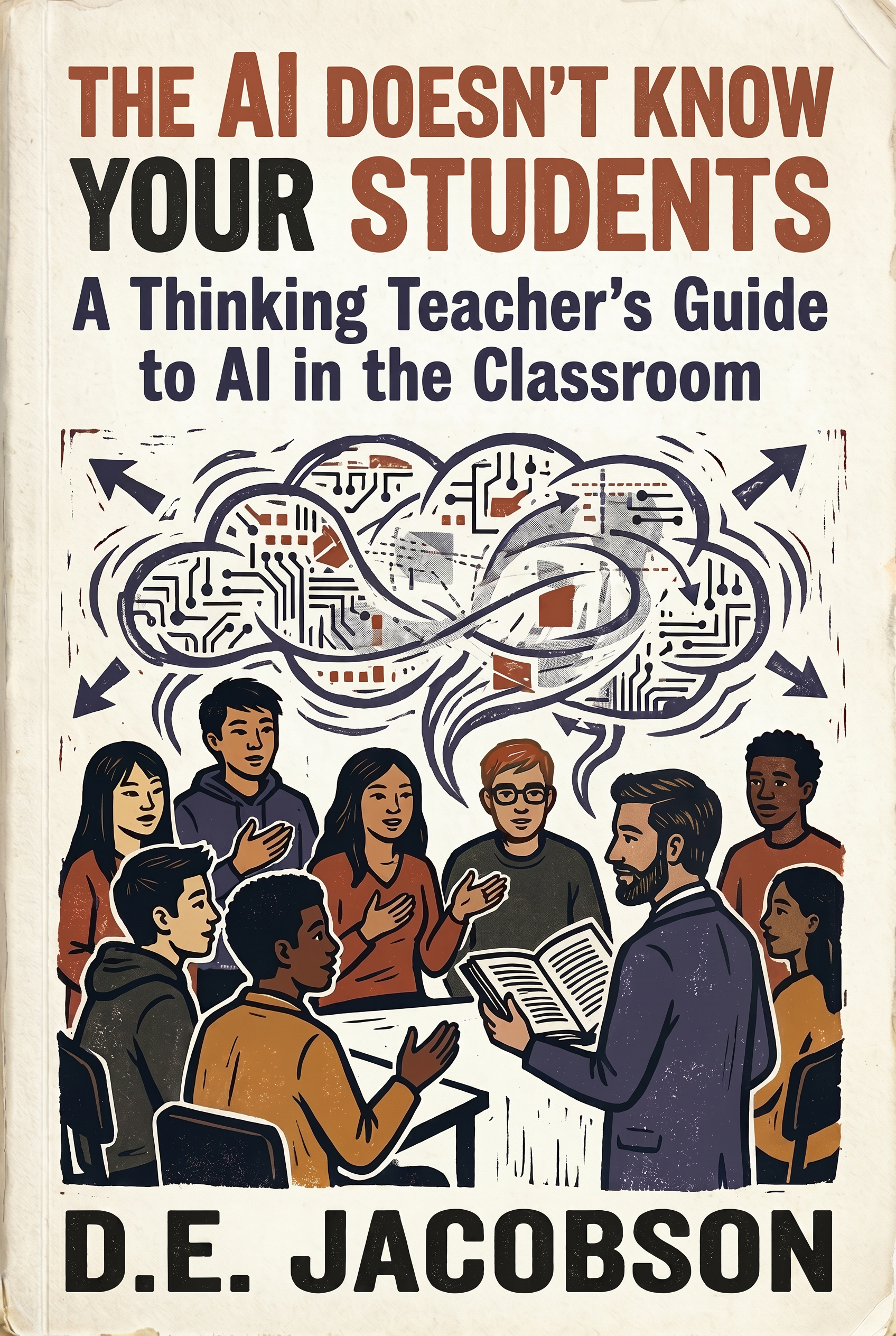
The AI Doesn’t Know Your Students
A Thinking Teacher’s Guide to AI in the Classroom
There’s a version of AI that gets sold to schools — in consultants’ slide decks and administrative memos. Then there’s the version teachers are living with: a tool that can write a lesson plan in 30 seconds but has no idea who your third-period class is.
This book is a field guide for that second version. It covers what AI does (and doesn’t do), how to use it without handing over the parts of teaching that matter, and how to help your students engage with it thoughtfully.
Practical. Honest. Written by a teacher, for teachers.
The AI Doesn’t Know Your Students is a practical AI book for teachers — written by David Jacobson, an AP educator with real classroom experience. This AI book for teachers covers what AI can do in education, how to use it without losing your professional judgment, and why the human side of teaching still matters most.
Twenty-four chapters. One argument.
That teaching is a relational act, and no tool — however capable — can replace the teacher who knows the student. The second edition adds two new chapters. Here’s how the book moves.
Section oneThe Foundation
What AI is doing when it generates text, what that means for learning, and what it means to teach in an international school.
- 1. The Shape, Without the SubstanceAI can produce lesson-shaped things. What’s missing is the thinking, the culture, the friction that teaches.
- 2. Behind the FirewallWhat actually works in a school with filters, privacy rules, and the constraints you already live inside.
- 3. Teaching Across LanguagesAI can translate. It can’t sit with a student who is thinking in two languages at once.
- 4. Rules of EvidenceYour exam board doesn’t care how polished something looks. It cares whether there’s evidence you judged the work.
- 5. Culture, Pressure, and the AI ClassroomStudents bring home economics and family expectations into every interaction with these tools. That changes what they do with them.
- 6. What the Room RevealedPut a real tool in front of a real classroom and it shows you what you’ve been teaching — and what you haven’t.
Section twoThe People in the Room
The cultural pressures on your students and the design frameworks that let you build a classroom that works for the students you have.
- 7. The Promise Every Tool MakesAn honest look at what AI can take off your plate, and what it can’t no matter what the demo promises.
- 8. The Invisible PrepThe real payoff isn’t in class. It’s in the quiet prep work that lets you show up more ready than you were yesterday.
- 9. The Teacher’s WorkbenchStop using someone else’s template. Build a small set of tools around how you think.
- 10. The Filing Cabinet You Never Clean OutEvery teacher has a mess of old lessons, feedback snippets, and notes. Make it usable again without spending your summer on it.
- 11. The Data You Already HaveYou already know things about your students no tool will ever know. Here’s how to make that knowledge usable.
- 12. Working With the GrainThe smartest response to AI isn’t to ban it. It’s to design tasks where real thinking still has to happen.
- 13. Thirty-Two EssaysUse AI to move through the stack. Keep your voice front and center in the feedback.
- 14. The Student in Front of YouAI can scaffold a struggling reader. You’re the one who knows whether they need more time or a different door in.
Section threeThe Field Guide
Lesson planning, feedback, assessment, differentiation — each chapter built around a real classroom problem with practical tools at the end.
- 15. Working Through SomethingPrompting isn’t a shortcut. It’s a thinking move worth teaching alongside your curriculum.
- 16. The Mirror, Not the ToolEvery tool is a mirror. What you see reflected is what you emphasize, what you skip, and what your assessments measure.
- 17. The Snapshot New in this edition. The version of a student a teacher carries, and the version an AI model builds, are the same kind of thing: frozen at one moment. What that costs, and what it’s still worth.
- 18. The AI Doesn’t Know Your Student (But Acts Like It Does) New in this edition. Hand a tool a label like “unmotivated” and it adjusts to the stereotype, not the kid. Give it the rubric instead of the name.
- 19. What You Can’t See From HereThere’s a difference between what you can measure and what you know. The most important moves are often the invisible ones.
- 20. What AI Reveals About Your SchoolYour school already has gaps between divisions and grade levels. AI just makes them visible.
Section fourThe Bigger Questions
School-wide alignment, academic integrity, and what teaching is for when the technology in the room is impressive.
- 21. When It Stops Being OptionalThe moment AI becomes structural, schools have to decide what we owe students who don’t have it at home.
- 22. There Is No Neutral AIThe tools your students use carry decisions about whose knowledge matters. Those decisions aren’t neutral.
- 23. The Wrong ArgumentStop asking whether AI is good or bad. Start asking what teaching is for, and whether this tool serves that.
- 24. What Teaching Is ForTeaching is a relational act. You know your students across time in a way AI cannot. That knowing matters more now, not less.
The quiet note after. What stays when the tools change — and what to carry forward.
Read by teachers, leaders, and AI educators.
“Jacobson directly addresses how AI can inform solid CRP practices without students losing meaningful engagement through productive struggle. He acknowledges the classroom implications of mianzi — face — as social currency, writing that ‘a learning environment that treats public error as a neutral or positive event is asking students who understand mianzi to absorb a social cost that other students aren’t paying.’ This book takes the cross-cultural realities of our classrooms seriously.” — Diana J., 8th Grade Humanities Teacher
“It’s a really accessible read! I discussed Ch. 20 ‘There is no neutral AI’ with my students in our weekend AI Fluency Advanced course earlier and it really helped them look at AI as something much more than a technology. We were reflecting about the geopolitical undercurrents of the ‘AI arms race’ with your passage on how ‘tech has always been power and how this has been contested.’” — Jen Chan, Innovative AI-fluent educator | AI for K12 academic learning
“I’ve been thinking a lot about AI and Education lately. As promised, I’m sharing some of the provocations I found in (Shanghai American School) teacher David E. Jacobson’s recent book. This line is stuck in my mind: ‘Better outputs. No better understanding.’ How is your school navigating this tension?” — Samuel J. Richards, Curricular Leader | IB Specialist | Programmatic Innovator | Author
Available on Amazon.
Practical enough for a planning period, honest enough to help.